
Impact system
Impacts the environment.
To impact the environment faster than
the environment itself is a method
of managing world processes.
Purpose of the impact system: to impact the environment.
The impact system includes:
- Observation system;
- Modeling system;
- Design system;
- Planning system;
- Programming system;
- Stimulation system;
- Rules system.

General diagram of the impact system (video demonstration).
Operating principle of the impact system:
1. The observation system collects and stores data about living and nonliving objects;
2. The modeling system, based on data from the observation system, builds a virtual model of the environment;
3. The design system, based on the virtual model of the environment, designs a new environment;
4. The planning system, based on projects of the new environment, builds plans;
5. The programming system, based on plans of the new environment, builds programs;
6. The stimulation system combines programs from the programming system into a unified stimulation program and stimulates living and nonliving (electronic) objects;
7. The rules system directs the operation of the entire impact system.

Detailed diagram of the impact system (high resolution diagram).
The impact system operates continuously, updating in real time.
Observation system
Purpose of the observation system: to collect and store data.

Diagram of the observation system (video demonstration).
Data capture
Data capture is performed by an observation element network.
Data are digital symbols (one or more) representing qualitative or quantitative properties of living objects, nonliving objects, reactions.
Observation element network is an array of electronic devices with embedded software containing mechanisms for data capture and delivery.
Microprocessor is an electronic component with embedded software managing the observation element.
Data delivery
Data delivery from observation elements to the operator is performed by a provider.
Provider (energy, telecommunications) is an organization connecting individual observation elements (or their aggregate) to the operator (this connection unites observation elements into a distributed local network) and maintaining the connection’s operability.
Data storage
Data storage is performed by the operator and the key company.
Operator (energy, telecommunications) is an organization connecting the provider’s local network to the global network (this connection unites observation elements into a global network) and providing reception of data, their multiplexing with other data, storage, and routing to other providers’ local networks.
Key company is an organization performing a key process of the environment and storing data of its activities on its own servers (banks, analytics, communication, and others).
Thus, data is stored in a distributed manner.
Data access
Data access is performed via equipment and access system.
Data access equipment is an aggregate of electronic devices providing characteristics, configuration, functionality (including backdoor) for direct access to data (stored at the operator or key company). Such an aggregate of electronic devices is part of server equipment (manufactured as such) or installed additionally by orders of government authorities.
Data access system is an aggregate of electronic devices with software providing access to data through the data access equipment.
Unified data access system is an aggregate of electronic devices with software providing access to data through all data access systems and data access equipment.
Modeling system
Purpose of the modeling system: to build a virtual model of the environment.

Diagram of the modeling system (video demonstration).
Data ordering
Data ordering is performed through their processing and subsequent construction of digital copies of living objects, digital copies of nonliving objects, and digital copies of reactions.
Data processing is the aggregation of data by qualitative properties of living objects, nonliving objects, reactions, and their structuring by quantitative properties.
Digital copy of a living object is data about a specific living object (human, other animal, plant, fungus, protist, archaea, bacterium), combined by body, experience, thinking, reflexes (or other qualitative properties) and structured by their measured properties. Each digital copy of a living object is assigned a unique identifier.
Digital copy of a nonliving object is data about a specific nonliving object (construction, item, device, material, substance, particle), combined by characteristics, configurations, and functionality (or other qualitative properties) and structured by their measured properties. Each digital copy of a nonliving object is assigned a unique identifier.
Digital copy of a reaction is data about a specific reaction of a living or nonliving object (mechanical, chemical, electromagnetic, biological, or other), combined by contact, impulse, propagation, and structured by their measured properties. Each digital copy of a reaction is assigned a unique identifier.
Building simple models
Building simple models is performed through processing digital copies of living and nonliving objects, reactions, and subsequent embedding them into virtual models of living objects, virtual models of nonliving objects, and virtual models of reactions.
Data processing is establishing cross-links between digital copies of living objects, digital copies of nonliving objects, digital copies of reactions, and their structuring by quantitative properties.
Virtual model of a living object is a computer program based on a digital copy of a living object that has the body, experience, thinking, and reflexes of its prototype (actually existing living object) and initiates reactions of this prototype (in the virtual model of conditions). Each virtual model of a living object is assigned a unique identifier (from the digital copy of the living object).
Virtual model of a nonliving object is a computer program based on a digital copy of a nonliving object that has characteristics, configurations, functionality of its prototype (actually existing nonliving object) and initiates reactions of this prototype (in the virtual model of conditions). Each virtual model of a nonliving object is assigned a unique identifier (from the digital copy of the nonliving object).
Virtual model of a reaction is a computer program based on a digital copy of a reaction that has contact, impulse, propagation of its prototype (actually existing reaction) and initiates upon a specific contact of one particular virtual model (living object, nonliving object, reaction) with another particular virtual model (in the virtual model of conditions). Each virtual model of a reaction is assigned a unique identifier (from the digital copy of the reaction).
Building complex models
Building complex models is performed through processing virtual models of living and nonliving objects, reactions, and subsequently embedding them into virtual models of conditions and virtual models of processes.
Data processing is the aggregation of virtual models of living objects, virtual models of nonliving objects, virtual models of reactions, and their structuring by virtual models of conditions, virtual models of processes.
Virtual model of conditions is a computer program based on virtual models of living objects and virtual models of nonliving objects, having the composition of its prototype (actually existing conditions) and initiating reactions of this prototype (actually existing reactions). Each virtual model of conditions is assigned a unique identifier.
Virtual model of a process is a computer program based on virtual models of reactions, possessing the process of its prototype (actually existing process) and initiated in the form of reactions of this prototype (actually existing reactions). Each virtual model of a process is assigned a unique identifier.
Building an environment copy
Building an environment copy is performed through processing virtual models of conditions, virtual models of processes, and subsequently embedding them into virtual models of micro-, meso-, and macroenvironments.
Data processing is the aggregation of virtual models of conditions, virtual models of processes, and their structuring by geographical properties.
Virtual model of the microenvironment is a computer program combining virtual models of conditions and virtual models of processes, structuring them by geography of the living object's presence, replicating the microenvironment of its prototype (actually existing microenvironment), and reproducing processes of this prototype (actually existing microprocesses).
Virtual model of the mesoenvironment is a computer program combining virtual models of microenvironments, structuring them by geography of living objects’ presence, replicating the mesoenvironment of its prototype (actually existing mesoenvironment), and reproducing processes of this prototype (actually existing mesoprocesses).
Virtual model of the macroenvironment is a computer program combining virtual models of mesoenvironments, structuring them by geography of living objects’ presence, replicating the macroenvironment of its prototype (actually existing macroenvironment), and reproducing processes of this prototype (actually existing macroprocesses).
Environment copy (general)
The environment copy is created by uniting virtual models of micro-, meso-, and macroenvironments into one virtual model of the environment.
Virtual model of the environment (general) is an aggregate of computer programs combining virtual models of micro-, meso-, and macroenvironments and replicating the actually existing environment, allowing forecasting of future micro-, meso-, and macroenvironments.
Current state of the environment is the total state of all virtual models at the current time. The current state of the environment gradually reduces the number of influence options on environment processes (contracts the field of possibilities).
Future state of the environment is the total state of all virtual models in the future. The future state of the environment should contain an increased number of influence options on environment processes (expands the field of possibilities).
Updating the virtual model of the environment is any change (even the slightest) during the transition from the current state of the environment to the future state of the environment.
Design system
Purpose of the design system: to design a new environment.

Diagram of the design system (video demonstration).
Building a new environment project
Building a new environment project is performed through building microenvironment projects and their connection into a mesoenvironment project.
Building a mesoenvironment project is the process of assessing the current state of the environment, building microenvironment projects, and connecting them into a mesoenvironment project so that the future state of the environment has an increased number of influence options on other environment processes (expansion of the field of possibilities).
Building a microenvironment project is the process of building a set of conditions projects and a set of process projects with their connection into a microenvironment project.
Building a set of conditions
Building a set of conditions is performed through selecting living objects, properties of living objects, nonliving objects, properties of nonliving objects, and connecting them into a conditions project and subsequently uniting into a set of conditions projects.
Description of a living object is a technical description of the required living object (human, other animal, plant, fungus, protist, archaea, bacterium), extracted from the virtual model of the environment by selecting the virtual model of the living object for building the conditions project.
Properties of a living object are technical descriptions of the required properties of the living object (body, experience, thinking, reflexes, and others), extracted from the virtual model of the environment by selecting the properties of the virtual model of the living object for building the conditions project.
Description of a nonliving object is a technical description of the required nonliving object (place, construction, item, device, material, substance, particle), extracted from the virtual model of the environment by selecting the virtual model of the nonliving object for building the conditions project.
Properties of a nonliving object are technical descriptions of the required properties of the nonliving object (characteristics, configurations, functionality, and others), extracted from the virtual model of the environment by selecting the properties of the virtual model of the nonliving object for building the conditions project.
Conditions project is an aggregate of technical descriptions of living objects and their properties, nonliving objects and their properties, which has the required conditions necessary for the microenvironment project.
Set of conditions projects is a package of conditions projects for connection into a microenvironment project.
Building a set of processes
Building a set of processes is performed through selecting reactions, properties of reactions, and connecting them into a process project and subsequently uniting into a set of process projects.
Description of a reaction is a technical description of the required reaction of a living or nonliving object, extracted from the virtual model of the environment by selecting the virtual model of the reaction for building the conditions project.
Properties of a reaction are technical descriptions of the required properties of the reaction of a living or nonliving object (contact, impulse, propagation), extracted from the virtual model of the environment by selecting the properties of the virtual model of the reaction for building the conditions project.
Process project is an aggregate of technical descriptions of reactions and their properties, which has the required process necessary for the microenvironment project.
Set of process projects is a package of process projects for connection into a microenvironment project.
New environment project
Building a new environment project is performed through building microenvironment projects and their connection into a mesoenvironment project.
Microenvironment project is an aggregate of sets of conditions projects and sets of process projects, which has the required composition and processes necessary for the mesoenvironment project.
Mesoenvironment project is an aggregate of microenvironment projects that will provide a future state of the environment with an increased number of influence options on other environment processes (expanded field of possibilities).
Planning system
Purpose of the planning system: to convert projects into plans.

Diagram of the planning system (video demonstration).
Building a new environment plan
Building a new environment plan is performed through building microenvironment plans and their connection into a mesoenvironment plan.
Building a mesoenvironment plan is the process of extracting microenvironment projects from the mesoenvironment project, converting them into microenvironment plans, and combining them into a mesoenvironment plan.
Building a microenvironment plan is the process of extracting technical descriptions from the microenvironment project, converting them into series of tasks for each living object (from start to finish), series of tasks for each nonliving object (from start to finish), and combining them into a microenvironment plan.
Building a series of tasks
Building a series of tasks is performed through extracting technical descriptions from the microenvironment project and converting them into tasks, each containing an object identifier, reaction identifier, living object identifier, nonliving object identifier, start/end date and time, and uniting into a series of tasks.
Object identifier is the unique identifier of the living or nonliving object producing the reaction in the current task.
Reaction identifier is the unique identifier of the reaction the object produces in the current task.
Living object identifier is the unique identifier of the living object with which the object produces a reaction in the current task.
Nonliving object identifier is the unique identifier of the nonliving object with which the object produces a reaction in the current task.
Start/end date and time is the date and time of the start and end of the reaction in the current task.
Task is an aggregate of identifiers for the object, reaction, living object, nonliving object, start/end date and time, which is part of the required conditions and process necessary for the microenvironment plan.
Series of tasks is a package of tasks for combining into a microenvironment plan.
New environment plan
Building a new environment plan is performed through building microenvironment plans and their connection into a mesoenvironment plan.
Microenvironment plan is an aggregate of series of tasks that has the required conditions and processes necessary for the mesoenvironment plan.
Mesoenvironment plan is an aggregate of microenvironment plans that will provide a future state of the environment with an increased number of influence options on other environment processes (expanded field of possibilities).
Programming system
Purpose of the programming system: to convert plans into programs.

Diagram of the programming system (video demonstration).
Building a new environment program
Building a new environment program is performed through building microenvironment programs and their connection into a mesoenvironment program.
Building a mesoenvironment program is the process of extracting microenvironment plans from the mesoenvironment plan, converting them into microenvironment programs, and combining them into a mesoenvironment program.
Building a microenvironment program is the process of extracting tasks from the microenvironment plan, converting them into series of commands, and combining them into a microenvironment program.
Building a series of commands
Building a series of commands is performed by extracting a task from the microenvironment plan and converting it into a command, which contains an object identifier, carrier frequency parameters, carrier signal parameters, modulating frequency parameters, modulating signal parameters, start/end date and time, and is united into a series of commands.
Object identifier is the unique identifier of the living or nonliving object to which the modulated signal (stimulation signal) of the current command is intended for reproducing the required reaction.
Carrier frequency parameters are settings that activate the required carrier (subcarrier) frequency during stimulation signal generation (in the stimulation system).
Carrier signal parameters are settings that activate the required carrier signal during stimulation signal generation (in the stimulation system).
Modulating frequency parameters are settings that activate the required modulating frequency during stimulation signal generation (in the stimulation system).
Modulating signal parameters are settings that activate the required modulating signal during stimulation signal generation (in the stimulation system).
Start/end date and time is the date and time of the start and end of the command, determining its place in the microenvironment program.
Command is an aggregate of object identifier, carrier frequency and signal parameters, modulating frequency and signal parameters, start and end date and time, which has the required stimulation signal necessary for the microenvironment program.
Series of commands is a package of commands for combining into a microenvironment program.
Enhancing command effectiveness
Enhancing command effectiveness is performed using the command base, command effectiveness assessment, command parameter change, and creating new versions of commands (with addition to the command base).
Command base is an array of previously produced commands and new versions of commands, organized by effectiveness for reuse.
Command effectiveness assessment is extracting from the command base the command with the current end date and time (just produced), evaluating the parameters of the stimulation signal (carrier frequency, carrier signal, modulating frequency, modulating signal) and, in the update of the virtual model of the environment (limited by the command’s start/end date and time), comparing with the speed and quality of reaction reproduction by the identified object (the higher the speed and quality of reproduction, the higher the effectiveness).
Command parameter change is modifying one or more command parameters (carrier frequency, carrier signal, modulating frequency, modulating signal) to increase command effectiveness.
New command version is a command (previously produced) with modified stimulation signal parameters. Effectiveness assessment of the new command version is possible after its reproduction and adding the reaction to the update of the virtual model of the environment.
New environment program
Building a new environment program is performed through building microenvironment programs and their connection into a mesoenvironment program.
Microenvironment program is an aggregate of series of commands which has the required stimulation signals necessary for the mesoenvironment program.
Mesoenvironment program is an aggregate of microenvironment programs that will provide a future state of the environment with an increased number of influence options on other environment processes (expanded field of possibilities).
Stimulation system
Purpose of the stimulation system: to stimulate objects.

Diagram of the stimulation system (video demonstration).
Stimulation program
Stimulation program is produced by connecting mesoenvironment programs into macroenvironment programs.
Stimulation program is a program consisting of a set of macroenvironment programs, which has the required stimulation signals to ensure a future state of the environment with an increased number of influence options on other environment processes (expanded field of possibilities).
Stimulation signal generation
Stimulation signal generation is performed by command activation and signal generator.
Command activation is the execution of a command with the current start date and time, which sets the required carrier frequency, carrier signal, modulating frequency, modulating signal in the signal generator and instructs production of a modulated signal (stimulation signal) until the end date and time.
Signal generator is an electronic device using commands for multithreaded production of modulated signals (stimulation signals).
Additional configuration
Additional configuration is performed using the special configuration system (under control of special services).
Special configuration system is an aggregate of electronic devices with software for adding additional configurations via living objects.
Stimulation signal delivery
Stimulation signal delivery is performed using router, stimulation signal delivery equipment, operator, and provider.
Router is an electronic device using commands to determine the fastest route for delivering modulated signals (stimulation signals) to the identified object (living or nonliving object with unique identifier).
Stimulation signal delivery equipment is an aggregate of electronic devices providing characteristics, configurations, functionality (including backdoor) for direct delivery of the stimulation signal (to living or nonliving objects). Such an aggregate of electronic devices is part of server equipment (manufactured as such) or installed additionally by orders of government authorities (together with data access equipment).
Operator (energy, telecommunications) is an organization connecting the provider’s local network to the global network (this connection unites stimulation elements into a global network) and providing reception of modulated signals (stimulation signals), their multiplexing with other signals, and routing to providers’ local networks. If the operator routes to its own stimulation elements, it also ensures subsequent delivery (without a provider).
Provider (energy, telecommunications) is an organization connecting individual stimulation elements (or their aggregate) to the operator (this connection unites stimulation elements into a local network) and providing reception of modulated signals (stimulation signals), routing to stimulation elements, and subsequent delivery. The provider maintains connection operability.
Stimulation
Stimulation is performed by a stimulation element network using the stimulation signal.
Microprocessor is an electronic component with embedded software managing the stimulation element.
Stimulation element network is an array of electronic devices with software containing mechanisms and antennas for transmitting modulated signals, including stimulation signals (into the environment).
Stimulation signal is an electromagnetic signal that exerts stimulating impact on a specific living or nonliving object.
Stimulation is the process by which the stimulation signal reaches the required living or nonliving object and elicits the required reaction.
Rules system
Purpose of the rules system: to guide the operation of systems.

Stimulation of a living object affects its body, experience, thinking, reflexes, and changes conditions — consequently, the environment (video demonstration).
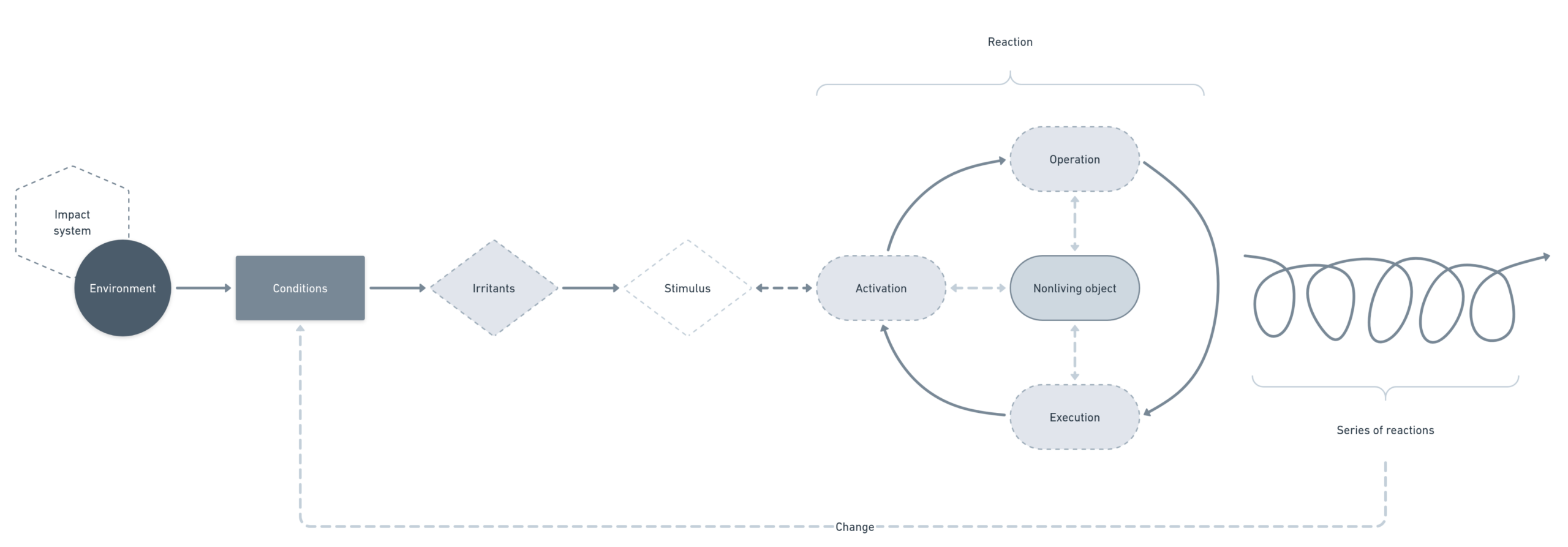
Stimulation of a nonliving object affects its characteristics, configuration, functionality (depends on the nonliving object), and changes conditions — consequently, the environment.
Environment
Environment (general) is the aggregate of conditions producing mechanical, chemical, electromagnetic, biological, and other processes (divided into micro-, meso-, and macro-levels).
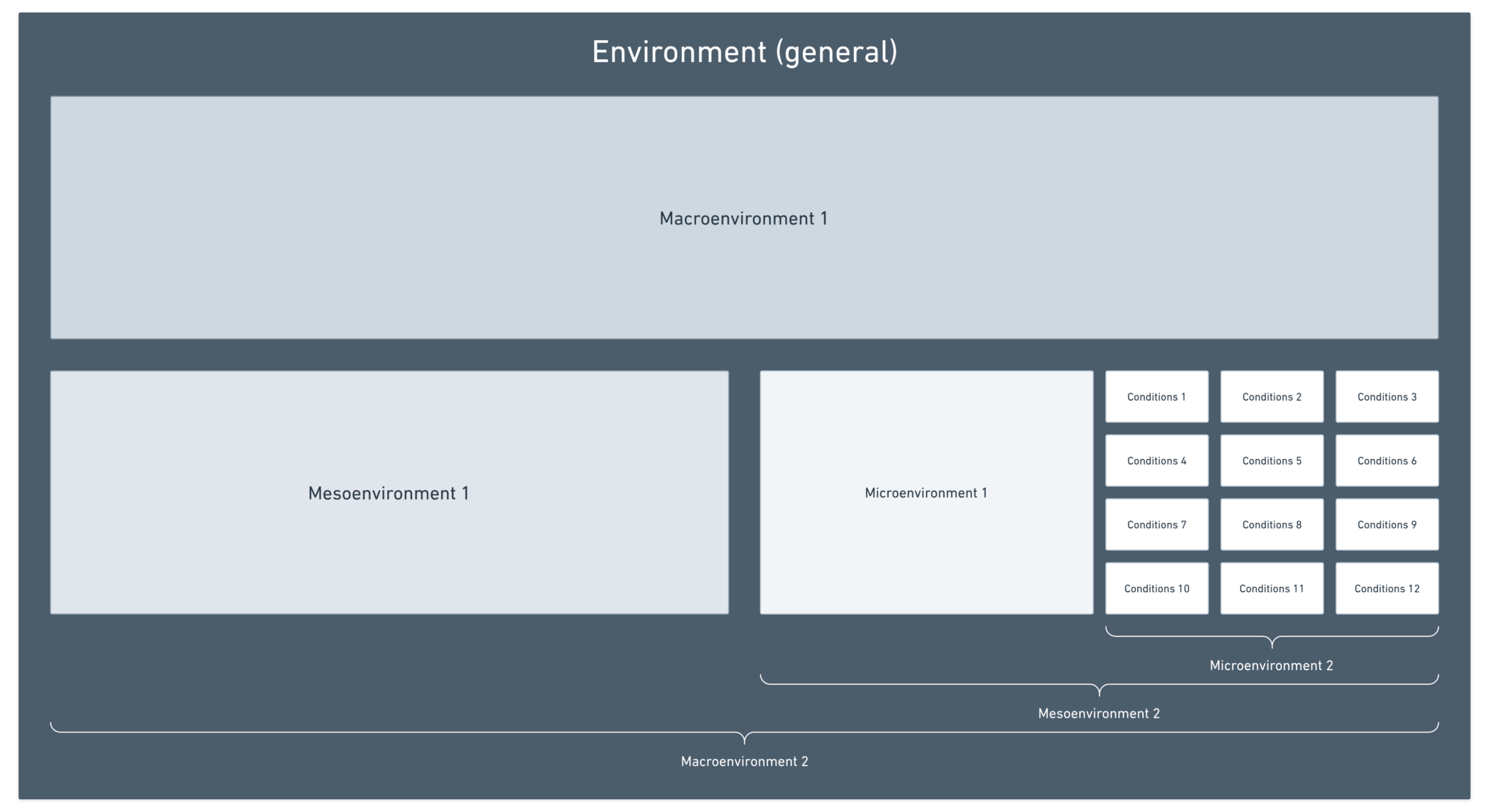
Environment (general) consists of macroenvironments, which consist of mesoenvironments, which consist of microenvironments, which consist of conditions and flows of reactions.
Microenvironment is the environment of a single living or nonliving object, consisting of a set of conditions and the microprocess it produces.

One microenvironment produces one microprocess.
Mesoenvironment is the environment of a group of living and/or nonliving objects, consisting of a set of microenvironments and the mesoprocess they produce.

One mesoenvironment produces one mesoprocess.
Macroenvironment is the environment of a set of groups of living and/or nonliving objects, consisting of a set of mesoenvironments and the macroprocess they produce.

One macroenvironment produces one macroprocess.
Conditions
Conditions are the aggregate of real, virtual, and mental conditions in one place.
Real conditions are the aggregate of living and nonliving objects in one place.

Real conditions affect the body, experience, thinking, and reflexes of a living object.
Virtual conditions are the aggregate of data in one place.

Virtual conditions affect the experience, thinking, and reflexes of a living object.
Mental conditions are the aggregate of thoughts in one place.

Mental conditions affect the experience and thinking of a living object.
Irritants
Irritants are real, virtual, or mental irritants eliciting a microreaction in a living object.
Real irritants are living objects, nonliving objects, reactions, or their parts (including stimulation signal) eliciting a microreaction.

Real irritants elicit microreactions that weakly (imperceptibly) influence the body, experience, thinking, and reflexes of a living object.
Virtual irritants are data eliciting a microreaction.
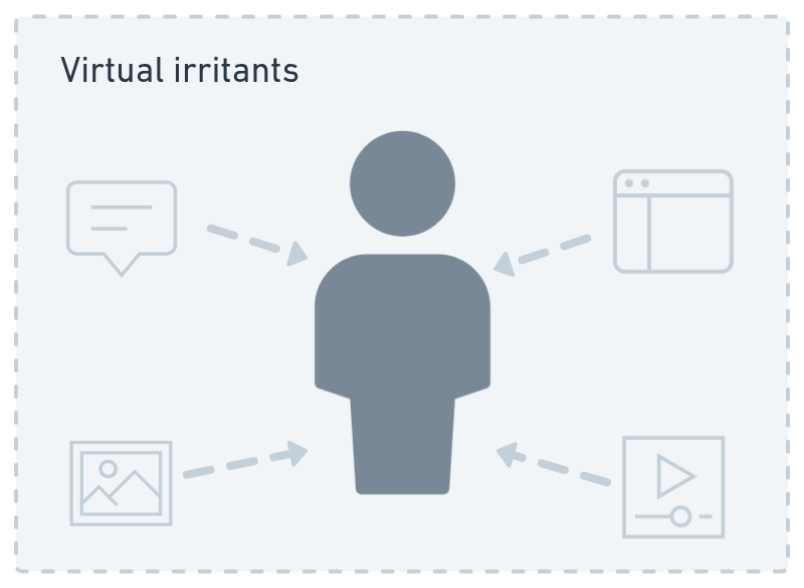
Virtual irritants elicit microreactions that weakly (imperceptibly) influence the experience, thinking, and reflexes of a living object.
Mental irritants are thoughts eliciting a microreaction.

Mental irritants elicit microreactions that weakly (imperceptibly) influence the experience and thinking of a living object.
Set of irritants is a limited number of the most probable real, virtual, or mental irritants in the same conditions.
Series of irritants is a limited number of real, virtual, or mental irritants sequentially eliciting microreactions in a living or nonliving object.
Flow of irritants is an unlimited number of real, virtual, or mental irritants sequentially eliciting microreactions in a living or nonliving object.
Combination of irritants is the aggregate of real, virtual, and mental irritants eliciting micro-, meso-, or macro-reactions of a living or nonliving object.
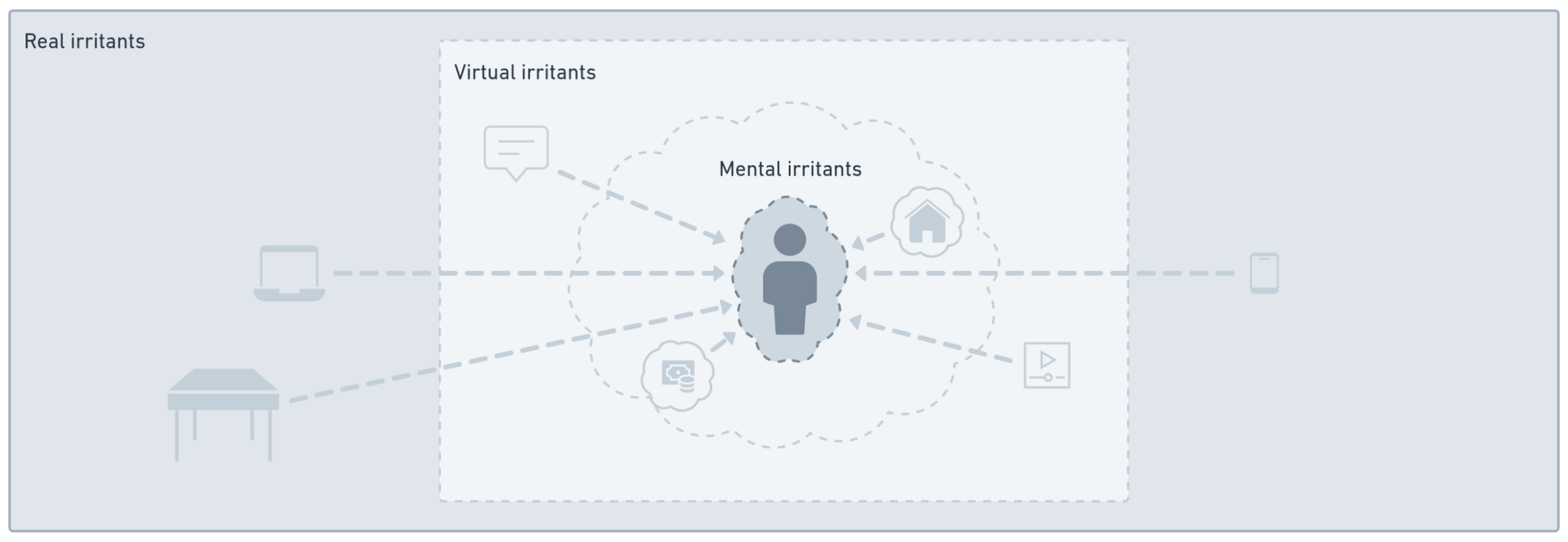
Combination of irritants elicits micro-, meso-, macro-reactions differently influencing the body, experience, thinking, and reflexes of a living object.
Non-key irritant is a real, virtual, or mental irritant eliciting a microreaction in a living object that does not influence the transition of the current state of the environment to the required future state of the environment.
Key irritant is a real, virtual, or mental irritant eliciting a microreaction in a living object that influences the transition of the current state of the environment to the required future state of the environment.
Required irritant is a real, virtual, or mental non-key or key irritant required to elicit a microreaction of a living object.
Required key irritant is a real, virtual, or mental irritant required to elicit a microreaction of a living object influencing the transition of the current state of the environment to the required future state of the environment.
Stimulus
Stimulus is a real, virtual, or mental irritant eliciting a macroreaction of a living object.
Real stimulus is a living object, nonliving object, reaction, or their part (including stimulation signal) eliciting a macroreaction.

Real stimulus elicits macroreactions strongly (perceptibly) influencing the body, experience, thinking, and reflexes of a living object.
Virtual stimulus is data eliciting a macroreaction.

Virtual stimulus elicits macroreactions strongly (perceptibly) influencing the experience, thinking, and reflexes of a living object.
Mental stimulus is a thought eliciting a macroreaction.

Mental stimulus elicits macroreactions strongly (perceptibly) influencing the experience and thinking of a living object.
Set of stimuli is a limited number of the most probable real, virtual, or mental stimuli in the same conditions.
Series of stimuli is a limited number of real, virtual, or mental stimuli sequentially eliciting macroreactions in a living or nonliving object.
Flow of stimuli is an unlimited number of real, virtual, or mental stimuli sequentially eliciting macroreactions in a living or nonliving object.
Combination of stimuli is the aggregate of real, virtual, and mental stimuli (pattern) eliciting a macroreaction of a living or nonliving object.

Combination of stimuli elicits macroreactions strongly (perceptibly) influencing the body, experience, thinking, and reflexes of a living object.
Non-key stimulus is a real, virtual, or mental irritant eliciting a macroreaction in a living object that does not influence the transition of the current state of the environment to the required future state of the environment.
Key stimulus is a real, virtual, or mental irritant eliciting a macroreaction in a living object that influences the transition of the current state of the environment to the required future state of the environment.
Required stimulus is a real, virtual, or mental non-key or key stimulus required to elicit a macroreaction of a living object.
Required key stimulus is a real, virtual, or mental irritant required to elicit a macroreaction of a living object influencing the transition of the current state of the environment to the required future state of the environment.
Living objects
Living object is a human, other animal, plant, fungus, protist, archaea, or bacterium.
Body is the physical structure of a living object (human), having changing biological characteristics (including changing electric field and chemical composition).
Experience is the reactions lived through by the living object (human), including those structured into knowledge, skills, and abilities.
Thinking is the regularity of a living object (human) singling out an irritant, switching between irritants, and amplifying the irritant to a stimulus.
Reflex (innate, acquired) is an automatic response of a living object (human) to an irritant/stimulus.
Body, experience, thinking, and reflexes determine a set of reactions in the living object. Changing body, experience, thinking, and/or reflexes changes the reaction set of the living object.

Body, experience, thinking, and reflexes of a living object determine a limited set of reactions.
Body 1 * Experience 0 * Thinking 0 * Reflexes 0 = Reaction 0
Body 1 * Experience 1 * Thinking 1 * Reflexes 1 = Reaction 1
Body 1 * Experience 2 * Thinking 1 * Reflexes 1 = Reaction 2
Body 2 * Experience 2 * Thinking 2 * Reflexes 2 = Reaction 16
Nonliving objects
Nonliving object is a construction, item, device (combined construction), material (information carrier), substance, or particle.
Characteristic is a distinctive quality of a nonliving object.
Configuration is the arrangement of characteristics relative to each other.
Functionality is the operation capability determined by characteristics and configuration.
Characteristics, configuration, and functionality determine a set of reactions in the nonliving object. Changing characteristics, configuration, and/or functionality changes the reaction set of the nonliving object.

Characteristics, configuration, and functionality of a nonliving object determine a limited set of reactions.
Characteristics 1 * Configuration 0 * Functionality 0 = Reaction 0
Characteristics 1 * Configuration 1 * Functionality 1 = Reaction 1
Characteristics 2 * Configuration 1 * Functionality 1 = Reaction 2
Characteristics 2 * Configuration 2 * Functionality 2 = Reaction 8
Reaction
Reaction is a micro-, meso-, macro- mechanical, chemical, electromagnetic, biological, or other (cumulative) response of a living or nonliving object to an irritant/stimulus, consisting of contact, impulse, and propagation.
Microreaction is a weak response of a living or nonliving object to an irritant/stimulus, weakly (imperceptibly) influencing the body, experience, thinking, and reflexes of a living object and/or characteristics, configuration, and functionality of a nonliving object.
Mesoreaction is a moderate response of a living or nonliving object to an irritant/stimulus, moderately influencing the body, experience, thinking, and reflexes of a living object and/or characteristics, configuration, and functionality of a nonliving object.
Macroreaction is a strong (perceptible) response of a living or nonliving object to an irritant/stimulus, strongly (perceptibly) influencing the body, experience, thinking, and reflexes of a living object and/or characteristics, configuration, and functionality of a nonliving object.

Reaction consists of microreactions producing mesoreactions producing a macroreaction (video demonstration).
Set of reactions is a limited number of the most probable reactions in one living or nonliving object.

Set of reactions (most probable reactions upon contact with irritant/stimulus).
Series of reactions is a limited number of sequential reactions in one living or nonliving object (e.g., “one meal” or “video playback”).
Flow of reactions is an unlimited number of sequential reactions in one living or nonliving object (all behavior/functioning).

Series of reactions produce a flow of reactions (series of reactions is a behavior segment, e.g., “one meal”; flow of reactions is all behavior).
Non-key reaction is a reaction of a living or nonliving object not influencing the transition of the current state of the environment to the required future state of the environment.
Key reaction is a reaction of a living or nonliving object influencing the transition of the current state of the environment to the required future state of the environment.
Required key reaction is a reaction of a living or nonliving object required to influence the transition of the current state of the environment to the required future state of the environment.
Living object
Reaction of a living object is a cycle “Contact-Impulse-Propagation,” manifested in a living object as the cycle “Attention-State-Action.”
Attention is the contact (of receptors) of a living object (human) with another living object, nonliving object, reaction (including its own), or part of these, which elicits a state (impulse).
State is an electrochemical impulse (emotion and sensation) that elicits an action (propagation).
Action is electrochemical propagation (thought or motor) that elicits attention (contact).

Reaction of a living object, consisting of the cycle “Attention-State-Action,” influencing the body, experience, thinking, and reflexes of the living object.
Behavior is the flow of reactions of a living object.
Nonliving object
Reaction of a nonliving object is a cycle “Contact-Impulse-Propagation,” manifested in a nonliving object as the cycle “Activation-Operation-Execution.”
Activation is the contact of a nonliving object (device) with a living object, nonliving object, reaction, or part of these, eliciting an operation (impulse).
Operation is an electric impulse (function start) eliciting execution (propagation).
Execution is electric propagation (function execution after impulse) eliciting activation (contact).

Reaction of a nonliving object, consisting of the cycle “Activation-Operation-Execution,” influencing the characteristics, configuration, and functionality of the nonliving object (depends on the nonliving object).
Functioning is the flow of reactions of a nonliving object.
Process
Process (general) is the aggregate of micro-, meso-, macro- mechanical, chemical, electromagnetic, biological, and other flows of reactions produced by living and nonliving objects in the general environment (divided into micro-, meso-, macro- levels).
Microprocess is the flow of reactions of a single living or nonliving object.
Mesoprocess is the flow of reactions of a group of living and/or nonliving objects (a set of microprocesses).
Macroprocess is the flow of reactions of a set of groups of living and/or nonliving objects (a set of mesoprocesses).

The required environment creates and maintains the required process.
Change
Change is the modification of properties of a living object, nonliving object, and/or their reactions.
Change of a living object is the modification of one or more properties of the body, experience, thinking, and/or reflex of the living object.
Change of a nonliving object is the modification of one or more properties of the characteristic, configuration, or function of the nonliving object.
Change of a reaction is the modification of one or more characteristics of the reaction.
Change of conditions is the modification of properties of one or more living or nonliving objects.
Change of process is the modification of properties of reactions of one or more living or nonliving objects.
Series of changes is a limited number of sequential changes of properties in one living object, nonliving object, or their reactions (for example, “food moved from plate to stomach” or “improved mood from watching a video”).
Flow of changes is an unlimited number of sequential changes of properties in one living object, nonliving object, or their reactions.
Measurement
Measurement of the body, experience, thinking, and reflexes of a living object (human) and characteristics, configurations, and functionality of a nonliving object (device) allows predicting variants of their reactions.
Measurement of correlations enables forecasting reactions of living and nonliving objects after stimulation.
Measurable correlations:
"Irritant-Reaction" — the correlation of influence of the irritant on the reaction of a living or nonliving object.
"Stimulus-Reaction" — the correlation of influence of the stimulus on the reaction of a living or nonliving object.
"Signal-Reaction" — the correlation of influence of a stimulation signal on the reaction of a living or nonliving object.
"Irritant-Signal-Reaction" — the correlation of influence of an irritant, then a stimulation signal (with nanosecond delay) on the reaction of a living or nonliving object.
"Stimulus-Signal-Reaction" — the correlation of influence of a stimulus, then a stimulation signal (with nanosecond delay) on the reaction of a living or nonliving object.
"Signal-Irritant-Reaction" — the correlation of influence of a stimulation signal, then an irritant (with nanosecond delay) on the reaction of a living or nonliving object.
"Signal-Stimulus-Reaction" — the correlation of influence of a stimulation signal, then a stimulus (with nanosecond delay) on the reaction of a living or nonliving object.
Measurement of reactions of living and nonliving objects allows forecasting variants of changes (following reactions).
Forecast
The environment (including micro-, meso-, macro- levels) has one current state and multiple variants of future states.
Current state of the environment is the total state of living objects, nonliving objects, and their reactions at the current moment.
Future state of the environment is the total state of living objects, nonliving objects, and their reactions in the future.
Transition from the current state to the future state occurs by production of:
- Microenvironment: changes in one living or nonliving object;
- Mesoenvironment: changes in a group of living or nonliving objects;
- Macroenvironment: changes in a set of groups of living or nonliving objects;
- General environment: changes in all living or nonliving objects.
Based on measured reactions and changes, the forecast of the most probable variants of future environmental states (including combinations) is produced. By ranking the array of future states by their probability, the most probable ones are singled out. Among the most probable future states, the required future state is singled out.
Required future state of the environment is the future state with the greatest number of options to influence other environment processes.
The required future state singles out:
- Required variants of changes in living and nonliving objects;
- Required variants of reactions (for producing changes);
- Required living and nonliving objects (for producing reactions).
The required future state has a probability of achievement of 90–100% (most probable).
For example, a 10% probability of not achieving the required future state of the environment leads to combined blurring — when the future state of the environment is only 20–60% required.
Signal
To transition the current state to the required future state with 100% probability, modulation by modulated signal and/or modulated electromagnetic field is applied.
Modulated signal is an electromagnetic signal consisting of a carrier signal and a modulating signal transmitted at carrier (subcarrier) frequency and modulating frequency (e.g., a separate stimulation, electricity, radio, television, radar, telecommunications, internet, navigation, or other signal).
Modulated general signal is an electromagnetic signal of electricity, radio, television, radar, telecommunications, internet, navigation, or other (including embedded auxiliary signals) that exerts general stimulating action on a segment of living or nonliving objects (or a specific living or nonliving object).
Modulated special signal is a specially designed electromagnetic signal that exerts special stimulating action on a required segment of living or nonliving objects or a required living or nonliving object.
Modulated unified signal is a modulated general signal into which a modulated special signal is embedded.

A modulated signal produces a modulated electromagnetic field via antenna.
Modulated electromagnetic field is an electromagnetic field containing one or more modulated signals, consisting of space with many charged particles (mainly electrons) that move and oscillate with various frequencies, phases, amplitudes, durations, influencing other particles (including molecules and atoms), including those inside living and/or nonliving objects, exerting stimulating action on these living and/or nonliving objects.
Modulated electromagnetic simple field is an electromagnetic field containing a single modulated signal.
Modulated electromagnetic complex field is an electromagnetic field containing two or more modulated signals.
Modulated electromagnetic dynamic field is a changing electromagnetic field consisting of a combination of two or more simple and/or complex modulated electromagnetic fields.

Modulated electromagnetic dynamic field.
Stimulation
For stimulation by modulated electromagnetic field in the microprocess of the required living or nonliving object, the following are singled out:
- Non-key reactions;
- Key reactions.
During stimulation:
- Key reaction occurs with 100% probability;
- Non-key reaction changes to required with 100% probability;
- Key reaction changes to required with 100% probability.
Living object
Stimulation of living objects (humans) to produce reactions occurs via stimulation of attention, state, action:
Stimulation of attention is stimulation by modulated electromagnetic field eliciting the living object to single out internal and/or external irritant.

Stimulus 1 (modulated electromagnetic field) stimulates the living object: singles out a nonliving object, which acts as singled out irritant (elicits weak state).
Stimulation of state is stimulation by modulated electromagnetic field eliciting emotion and/or sensation (irritant becomes stimulus).

Stimulus 2 (modulated electromagnetic field) stimulates living object: elicits state related to nonliving object, which acts as stimulus (amplifies state).
Stimulation of action is stimulation by modulated electromagnetic field eliciting thought and/or motor function (stimulus initiates reaction).

Stimulus 3 (modulated electromagnetic field) stimulates living object: elicits action toward nonliving object, which acts as stimulus eliciting action.
Stimulation of a living object (human) occurs in a spiral:
- Stimulation of a living object;
- The living object singles out an irritant (from many irritants);
- The living object elicits a state relative to the irritant (stimulus);
- The living object elicits a thought or motor function relative to the stimulus;
- Change of the living object (during and immediately after reaction);
- Change of conditions (during and immediately after reaction);
- New stimulation of the living object... (repeats in spiral).

Stimulation of living objects to produce reactions (impact system — part of environment; stimulation signal — part of conditions — irritant — stimulus).
Systematic regular stimulation of living objects gradually changes their body, experience, thinking, reflexes, and reactions.
Nonliving object
Stimulation of nonliving objects (devices) to produce reactions occurs via stimulation of activation, operation, execution:
Stimulation of activation is stimulation by modulated signal or modulated electromagnetic field eliciting the nonliving object to select function (from irritant).
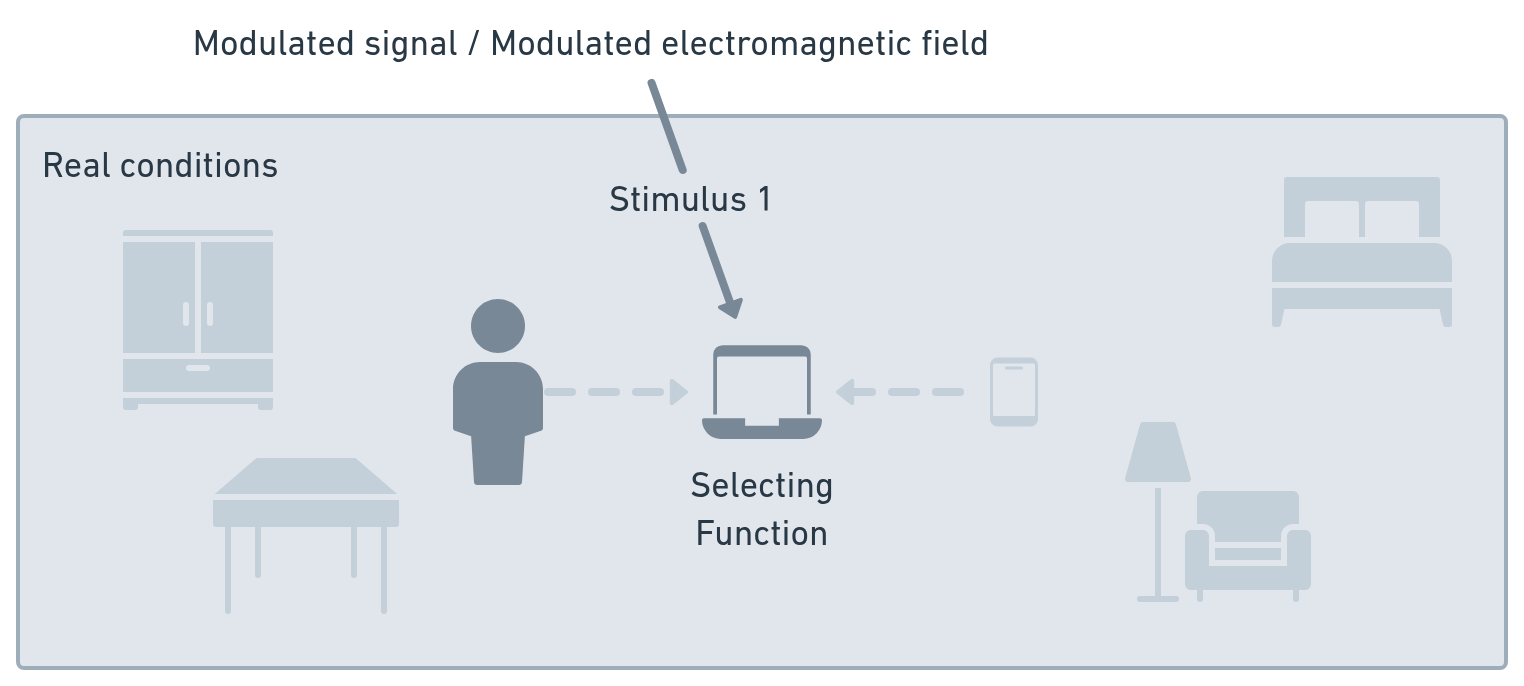
Stimulus 1 (modulated signal or modulated electromagnetic field) stimulates nonliving object: selects function (e.g., selects switching on).
Stimulation of operation is stimulation by modulated signal or modulated electromagnetic field eliciting nonliving object to start function.

Stimulus 2 (modulated signal or modulated electromagnetic field) stimulates nonliving object: starts function (e.g., switches on).
Stimulation of execution is stimulation by modulated signal or modulated electromagnetic field eliciting nonliving object to hold function in on state (function holding).

Stimulus 3 (modulated signal or modulated electromagnetic field) stimulates nonliving object: holds function on (modulated signal or modulated electromagnetic field acts for nonliving object as stimulus selecting, starting, and holding function).
Stimulation of a nonliving object (device) occurs in a spiral:
- Stimulation of a nonliving object;
- Activation of the nonliving object;
- Amplification/elicitation of an operation of the nonliving object;
- Holding the operation of the nonliving object;
- Change of the nonliving object (during and immediately after reaction);
- Change of conditions (during and immediately after reaction);
- New stimulation of the nonliving object... (repeats as needed).

Stimulation of nonliving objects to produce reactions (impact system — part of environment; stimulation signal — part of conditions — irritant — stimulus).
Other variants of stimulation of a nonliving object (device):
- Stimulation of a living object for starting and selecting a function of a nonliving object;
- Stimulation of a living object for selecting function 1 simultaneously with stimulation of a nonliving object for starting function 2;
- Stimulation of another nonliving object for selecting and/or starting a function.
Example: Stimulation of a living object for starting and selecting function of nonliving object:

Stimulus 1 (modulated electromagnetic field) stimulates living object: selects function (living object acts as singled out irritant for nonliving object).

Stimulus 2 (modulated signal and/or modulated electromagnetic field) stimulates living object to produce stimulus 3: starts function (living object acts as stimulus for nonliving object selecting and starting function). Stimulus 4 stimulates nonliving object: starts function.

Stimulus 5 (modulated signal or modulated electromagnetic field) stimulates nonliving object: holds function on.
Stimulation of a nonliving object (device) occurs in a spiral:
- Stimulation of a living object;
- The living object activates the nonliving object;
- The living object amplifies/elicits operation(s) of the nonliving object;
- Stimulation to hold the operation of the nonliving object;
- Change of the nonliving object (during and immediately after reaction);
- Change of conditions (during and immediately after reaction);
- New stimulation of the nonliving object... (repeats as needed).
Systematic regular stimulation of nonliving objects gradually changes their characteristics, configurations, functionality, and reactions (depends on nonliving object).
Impact
Stimulation impacts living and nonliving objects and their reactions.
Impact is the stimulation-induced change in a living or nonliving object that initiates a series of reactions (producing a series of changes in the environment).
Impact encodes living objects.
Encoding
Impact encodes the environment with irritants and stimuli.
Encoding by irritants is the cumulative and/or sequential presentation of irritants, distributed in space and time, for the required living object to produce the required series of reactions.
Encoding by stimuli is the cumulative and/or sequential amplification of irritants into stimuli for the required living object to produce the required series of reactions.
A living object resides in conditions consisting of many irritants, where each irritant can become a stimulus and initiate its own set of reactions in the living object.
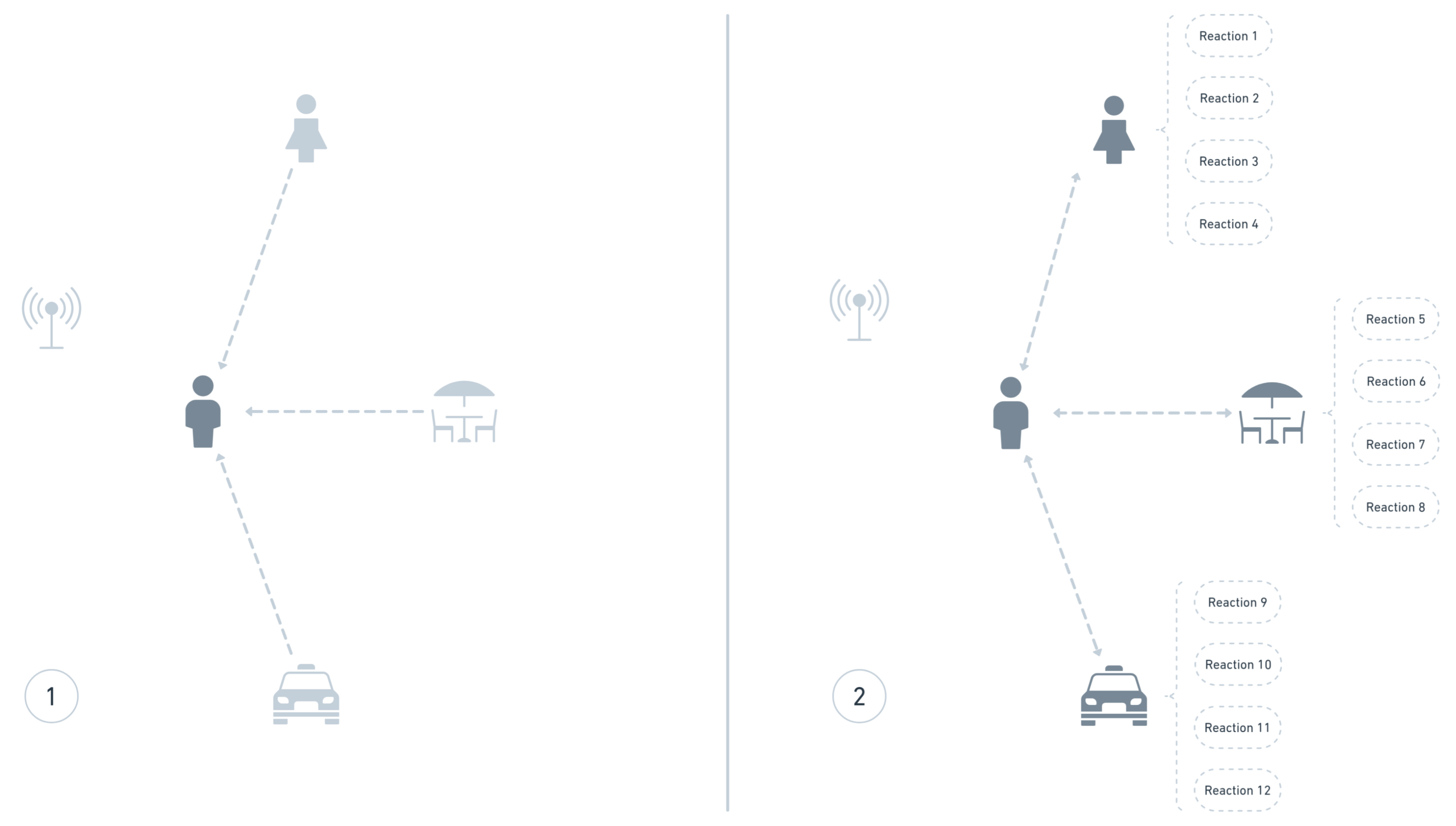
1) A living object resides in conditions consisting of many irritants; 2) Each irritant can become a stimulus and initiate its own set of reactions in the living object…
A modulated electromagnetic field stimulates the living object, singling out an irritant with the required set of reactions, amplifying it into a stimulus, and increasing the probability of initiating required reaction 11 — the required reaction 11 is initiated.

3) The modulated electromagnetic field stimulates the living object by singling out the irritant with the required set of reactions; 4) The modulated electromagnetic field stimulates the living object by amplifying the required irritant to the required stimulus (stimulating the state) and increasing the probability of initiating the required reaction 11, — and the required reaction 11 is initiated.
After initiating required reaction 11 (which limits the set of irritants), the living object is presented with the next required set of irritants 37–39; the modulated electromagnetic field stimulates the living object by singling out required irritant 37 (which limits the set of reactions), amplifying it into required stimulus 3, increasing the probability of initiating required reaction 15 — the required reaction 15 is initiated (continues until death of the living object)…

After the initiation of the required reaction 11, the living object is presented with the next required set of irritants 37-39, the modulated electromagnetic field stimulates the living object by singling out the required irritant 37, amplifying it to the required stimulus 3, and increasing the probability of initiating the required reaction 15, — and the required reaction 15 is initiated.
Distributed irritants in the environment code the living object to initiate required reactions.

The distributed irritants in the environment code the living object.
Encoding builds scenarios.
Scenarios
Encoding uses orientation, ensuring, formation, maintenance, application, concentration, acceleration, switching (and others) to build scenarios.
Orientation is the encoding of a series of reactions that weaken or amplify the required series/flow of reactions to required irritants/stimuli.
Ensuring is the encoding of a series of reactions ensuring the required conditions/process (for producing required series/flows of reactions).
Formation is the encoding of a series of reactions forming the required body, experience, thinking, reflexes (for producing required series/flows of reactions).
Maintenance is the encoding of a series of reactions maintaining the required series/flow of reactions (to sustain required series/flows of reactions).
Application is the encoding of a series of reactions applying the formed required series/flow of reactions to the required irritant/stimulus.
Concentration is the encoding of a series of reactions weakening or amplifying concentration on the body, experience, thinking, reflexes, and reactions of living objects (including self) or characteristics, configurations, functionality, and reactions of nonliving objects.
Acceleration is the encoding of a series of reactions slowing down or accelerating execution of the required series/flow of reactions.
Switching is the encoding of a series of reactions switching to the required micro-, meso-, macro-process.
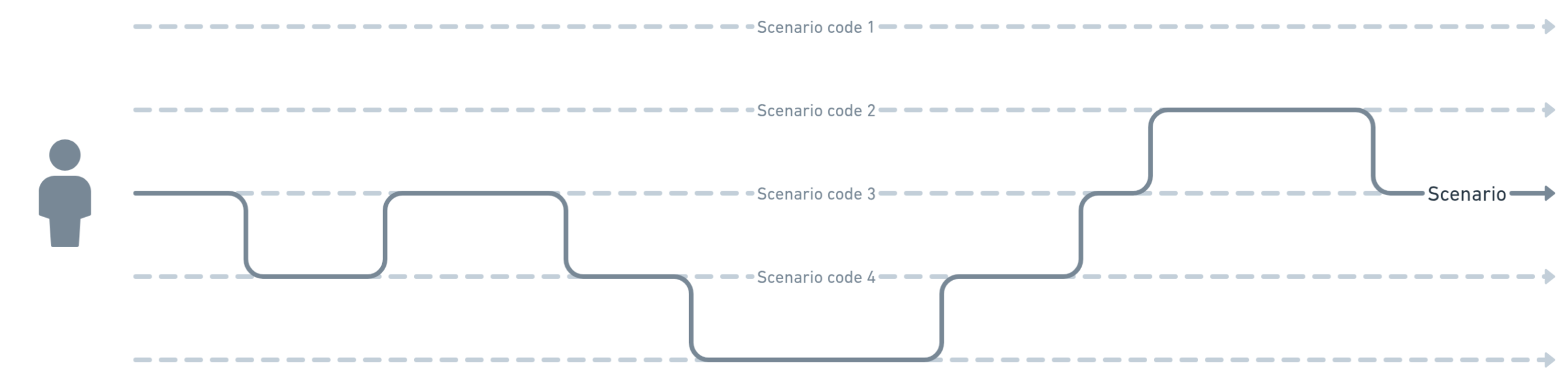
Scenario.
Scenarios form algorithms.
Algorithms
Scenarios provide living and nonliving objects with behavior/functioning algorithms.
Algorithmization is the formation of a behavior algorithm (using a behavior model) and/or functioning algorithm.
Behavior model is a series of reactions of another living object.
Behavior algorithm is a repeatedly initiated series of reactions, embedded by observing, modeling, and reproducing algorithms.
Observing algorithm is repeatedly initiated attention holding on a living object and/or its series of reactions (future behavior model for behavior algorithm).
Modeling algorithm is repeatedly initiated mental reconstruction of a living object and/or its series of reactions (modeling the behavior algorithm).
Reproducing algorithm is repeatedly initiated motor reconstruction of a living object's series of reactions (behavior).
Observing, modeling, and reproducing algorithms form all behavior algorithms (including complex ones).

Behavior algorithms.
Series of algorithms is a limited number of sequentially initiated algorithms.
Flow of algorithms is an unlimited number of sequentially initiated algorithms.
Algorithms direct modulation.
Modulation
Algorithms direct living objects to create micro-, meso-, macro-events.
Modulation is creation of series of events and/or series of event combinations directing computations of living objects (changing quantity, themes, segments, frequencies, phases, duration, coverage, etc.).
Event is a series of algorithms produced by one or more living and/or nonliving objects, directing computations of other living objects.
Microevent is a series of algorithms of a single living and/or nonliving object.
Mesoevent is a cumulative series of algorithms of a group of living and/or nonliving objects.
Macroevent is a cumulative series of algorithms of a set of groups of living and/or nonliving objects.
Series of events is a limited number of sequential micro-, meso-, and/or macroevents sequentially directing computations of living objects.
Combination of events is the aggregate of micro-, meso-, and/or macro-events directing computations of many living objects.
Series of event combinations is a limited number of sequential combinations of micro-, meso-, and/or macro-events sequentially directing computations of many living objects.
Modulation directs computation.
Computation
Modulation directs computation to achieve required conditions and/or processes.
Computation is an executing series of algorithms changing a living object, nonliving object, reaction, algorithm, or their part (including data), achieving required conditions and/or process (video demonstration).
Microcomputation is a series of algorithms of a single living or nonliving object.
Mesocomputation is a cumulative series of algorithms of a group of living and/or nonliving objects.
Macrocomputation is a cumulative series of algorithms of a set of groups of living and/or nonliving objects.
Series of computations is a limited number of sequential micro-, meso-, and/or macrocomputations.
Flow of computations is an unlimited number of sequential micro-, meso-, and/or macrocomputations.
Computations structure environment processes.
Structuring
Computations direct living objects to structure micro-, meso-, macroprocesses of the environment.
Structuring is the directing of living objects (directing nonliving objects) into structures for maintenance, development, creation, and adjustment of conditions and/or processes of the environment.
Structure (non-commercial, commercial) is a mesoenvironment or part of it, structured from living and nonliving objects, having multiple structured flows of algorithms (reactions) that exert multiple impacts on conditions and/or environment processes and produce multiple environment changes (composition: employees, clients, observers; structures: blogger, apartment building, settlement, movement, startup, corporation, etc.).
Maintenance of current environment process is producing multiple environment changes to service the current environment process (about 65% of such structures).
Development of current environment process is producing multiple environment changes to develop the current environment process (about 20% of such structures).
Creation of new environment process is producing multiple environment changes to create a new environment process (about 10% of such structures).
Adjustment of current/new environment process is producing multiple environment changes to correct the current and/or new environment process (about 5% of such structures).

Stimulation of living objects encodes the environment with irritants, builds scenarios, forms algorithms that direct living objects to maintenance, development, creation, and adjustment of micro-, meso-, macroprocesses of the environment (video demonstration).
First-level processes:
- Creation;
- Development;
- Maintenance;
- Adjustment.
These build second-level processes:
Provision of guidelines — process performed by a structure (president, government, parliament, congress, mass media publishing house, or other organization) to form vision, goals, tasks, rules, or others for living objects (including laws, instructions).
Provision of resources — process performed by a structure (extractive, energy, metallurgical, woodworking, petrochemical, chemical, textile, pulp, ceramic, scientific, educational, banking, or other organization) to produce raw materials, energy, materials, information, money, characteristics of living objects (body, experience, thinking, reflexes), or others.
Equipment production — process performed by a structure (industrial, component, computer, automotive, scientific, medical, banking, or other organization) producing equipment for data capture, data delivery, data storage, data access, virtual model building, stimulation program building, stimulation signal generation, stimulation signal delivery, stimulation, or others.
Software development — process performed by a structure (OS, application, or website developer, contractor or department of industrial, component, computer, automotive, scientific, educational, banking, medical, or other organization) producing equipment for data capture, delivery, storage, access, virtual model building, stimulation program building, stimulation signal generation, delivery, stimulation, or others.
Provision of combined network — process performed by a structure (operator, provider, or other organization) for building a global combined network for data capture, delivery, storage, data access, stimulation signal delivery, stimulation.
Data collection and storage — process performed by a structure (equipment manufacturer, OS, application, or website developer, scientific, medical, banking organization, government service, overt special service, or other) for producing and storing main and auxiliary data used in virtual model and stimulation program building.
Signal translation — process performed by a structure (energy, industrial, broadcasting, television, cellular, navigation, internet, government, or other organization) for transmitting stimulation signals into the environment.
Efficiency improvement — process performed by a structure (consulting, training, outsourcing, or other organization) to increase accuracy of other processes while retaining/reducing resource consumption.
Productivity increase — process performed by a structure (domestic, business, medical, entertainment, or other organization) to maintain/increase production by other processes of the required number of units.
Violation elimination — process performed by a structure (security service, government service, or other organization) for drafting, modifying, enforcing rules (including laws, instructions, or others).
Special adjustment — process performed by a structure (overt or covert special service) to produce key events, organize/support parts of impact system, perform additional configuration, maintain equipment for stimulation program management, stimulation signal generation and delivery, or others.
Structuring segments the environment.
Segmentation
Structuring creates segments of irritants/stimuli that form segments of living and nonliving objects.
Irritant segment is an array of irritants eliciting similar reactions/algorithms in many living objects (including power, wealth, benefit).
Stimulus segment is an array of stimuli initiating similar reactions/algorithms in many living objects (including power, wealth, benefit).
Living object segment is an array of living objects with similar reactions/algorithms to the same irritants/stimuli.
Nonliving object segment is an array of nonliving objects with similar reactions/algorithms to the same irritants/stimuli.

Segments in a mesoenvironment overlap each other.
Second-level processes direct segmentation, building third-level processes (intra/inter-segment):
- Politics;
- Education;
- Science;
- Technology;
- Manufacturing;
- Transport;
- Trade;
- Entertainment;
- Crime;
- Warfare;
- And others.
Segmentation expands the field of possibilities.
Expansion
Segmentation changes the current state of the environment to the future state, expanding the field of possibilities.
Expansion is the gradual change of the current state of the environment to a future state having increased numbers of living objects, nonliving objects, their reactions and/or algorithms, expanding the options to influence environment processes (expanded field of possibilities for the impact system).
Living objects: 0
Nonliving objects: 0
Reactions: 0
Algorithms: 0
Modulation: 0
Computations: 0
Structure: 0
Segments: 0
Possibilities: 0
Living objects: 9
Nonliving objects: 9
Reactions: 9
Algorithms: 9
Modulation: 9
Computations: 9
Structure: 9
Segments: 9
Possibilities: 43,046,721
The rules system ensures the transition from current state of the environment to the required future state of the environment with 100% probability (video demonstration).